Originally based in northeast Indiana where I grew up and founded a full-service ISP (remember those?) that specialized in web development, it didn't take
long to realize that this sort of thing wasn't ever going away and that I had been one of the lucky ones who chose a vocation after school that was going to
provide gainful employment - and one that I loved to do. So in 2000 I made my way to Chicago just before the dot-com bubble burst. Thankfully I had the skills
and experience to weather the storm and to this day, be it contract or full-time status, I've never been a single day out of work.
While I pride myself in having a full understanding of end-to-end development my specialty and what I most enjoy is front end programming. Ever since entering the
IT world I've always seemed to be that guy who fills a void most companies don't grasp or even have a title for - and that's the person who knows how to talk with
business, work with art directors and creative, take what they produce and know how to make it look pixel-perfect and then fully functional in whatever deploy the
project calls for. To this day I run into a lot of developers who say they can get the job done and, while good at coding, they fall short in the client-facing side
of things - the thing that gets seen by everyone from the customer to the CEO. And then there's the crunch time when a creative deliverable falls short. Yep, I'm
the guy who gets those issues resolved too. And I'm not too bad at coming up with the comps and subsequent creative for said project if the need arises.
Anyway, like a picture that speaks a thousand words, my past and present work should speak for itself. I've tried to put details on the past decade of projects I've
been involved with on this site for anyone to peruse. Also, if anyone is interested in some of the books that have shaped my skills I've got the core listed below.
JavaScript with Promises
Asynchronous JavaScript is everywhere, whether you’re using Ajax, AngularJS, Node.js, or WebRTC. This practical guide shows intermediate to advanced JavaScript
developers how Promises can help you manage asynchronous code effectively—including the inevitable flood of callbacks as your codebase grows. You’ll learn the
inner workings of Promises and ways to avoid difficulties and missteps when using them. Only problem I had with this book is that I ordered it and it was one
full year late in arriving. Then when it arrived it was only 75 pages. In the time it took to arrive I had become accustomeed to using promises in the real
world on a large client-facing application at the company I was working at, so in the end it served as a reference guide.
MongoDB - The Definitive Guide
Manage the huMONGOus amount of data collected through your web application with MongoDB. This authoritative introduction—written by a core contributor to the
project—shows you the many advantages of using document-oriented databases, and demonstrates how this reliable, high-performance system allows for almost infinite
horizontal scalability. This updated second edition provides guidance for database developers, advanced configuration for system administrators, and an overview
of the concepts and use cases for other people on your project. Ideal for NoSQL newcomers and experienced MongoDB users alike, this guide provides numerous
real-world schema design examples.
Sass And Compass In Action
Sass and Compass in Action is the definitive guide to stylesheet authoring using these two revolutionary tools. Written for both designers and developers, this
book demonstrates the power of both Sass and Compass through a series of examples that address common pain points associated with traditional stylesheet authoring.
The book begins with simple topics such as CSS resets and moves on to more involved topics such as grid frameworks and CSS3 vendor implementation differences.
With Sass and Compass the concept of object oriented CSS (OOCSS) is made possible. This means variable setting, mixins, partials, operations and inheritance can
now be done in style sheets, and is more easy than you might think.
Designing Interfaces
Covers everything related to patterns used for modern web (and desktop) interfaces. The book does not cover implementation topics but instead focuses on providing
the reader with numerous examples of user interfaces. There's a lot of practical design advice that you can utilize if you're in the field and also discussion on
what works and what does not in different scenarios.
Don't Make Me Think
This edition written in 2005, believe it or not, still contains fantastic information about web usability. The author keeps things simple and most of the
principles contained in this book although first shared in 2000 surprisingly still hold true today. Yes, the web has changed but what has not is humans and how they want
to interact with them. What the book doesn't cover is programming. "Don't Make Me Think" chooses to remain agnostic of any legacy or modern technology and instead focuses
on the why of how things should be done in a web application. It's a fast read and for veteran readers it helps remind us of things we sometimes forget about while
desigining interfaces.
AngularJS
Once in a while a technology comes into my view that I really really enjoy and am thoroughly impressed with. AngularJS is just one of those. Remarkably simple, this
JavaScript toolset language packs a punch. Created by Google it allows you to actually tie it in with the HTML of a web page, so in the DOM tags themselves you get
to add Angular declarations. Everything is just plain JavaScript so there's nothing proprietary about the way the controllers and services are constructed. It's got a
fairly robust API so while new, it's also highly usable. It supports testing and ties in nicely with other JS frameworks you may choose to work with. I built a fairly
substantial application with it and a charting library and jQuery - with results that were quite impressive.
PHP, MySQL, JavaScript & CSS
This book covers the basics of each technology and then explains in detail how they collectively work to create a complete web solution. 20 chapters, very well-written
and is probably one of the fastest ways to get started with a dynamic web site for LAMP, WAMP or MAMP stacks.
Learning C# 3.0
Great fundamentals book from O'Reilly by Jesse Liberty, a Microsoft Senior Program Manager, and Brian MacDonald. Includes solid chapter summaries, questions and exercises
to help provide working examples of what each one explains. Good for developers familiar with C# but not fluent with it - or if like me, maybe it's been awhile since you
used the language and just wanted a refresher. And even though C# is similar to other object oriented programming languages semantically it's best to
get the syntax down to avoid wasting time during coding. If you know C# just a little this book is an easy read and pretty much covers everything you need to know to get
up and running.
Learning Node
While living mostly on the client side of things I decided to broaden my realm of knowledge by learning some server-side tech that was gaining acceptance
in the web community so picked up a good source on Node from O'Reilly. This book weighs in at under 350 pages so it's a fast read and provides you with
the fundamentals of Node and explains modules, REPL and the asynchronous I/O model of Node through the description and how-to summary of several examples
put together by the author.
Programming ASP.NET 3.5
Never hurts to ground yourself from time to time by reading a book that covers the basics up to advanced and this O'Reilly books does just that.
Some developers get it, some do not - and that's ASP.NET is a programming language that, to think about mastering, marries the individual developer
to the concept of both front end and back end by the very nature of its framework. I personally feel this makes most programmers much more rounded
and in the process separates the men from the boys. It also makes one more highly valued in the MS development job space.
Beginning Android 4 Application Development
This fast-paced introduction to the newest release of Android OS gives aspiring mobile app developers what they need to know to program
for today's hottest Android smartphones and tablets. From using activities and intents and creating rich user interfaces to working with SMS,
messaging APIs, and the Android SDK, what you need is here.
HTML5 Canvas
HTML5 is jam-packed with features, and there's a lot to learn. This book gets you started with the Canvas element, perhaps HTML5's most
exciting feature. Learn how to build interactive multimedia applications using this element to draw, render text, manipulate images,
and create animation.
Flex 4 Cookbook
Just about six months after reading the Flex 3 Cookbook the Flex 4 Cookbook was published so I grabbed this up to quickly learn the differences
between the Halo components and Spark controls and Flex 4 (Gumbo) in general.
JavaScript Cookbook
The cookbooks from O'Reilly are great if you already know the basics of a programming language but want to learn proven methods of accomplishing
specific tasks rapidly. This is one of those books I would recommend for JavaScript programmers.
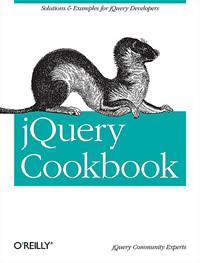
jQuery Cookbook
One of my favorite JavaScript libraries explained through real-world examples. This book greatly simplifies things and reduces the learning curve
by demonstrating how to use jQuery for anything from component creation to user interfaces that take full advantage of the built-in effects the
library includes.
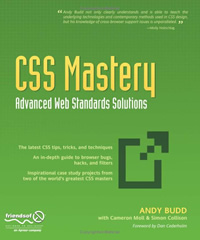
CSS Mastery: Advanced Web Standards Solutions
Excellent book on CSS, even covers CSS3 standards. It contains full explanations on the right way to utilize positioning and layout techniques
that many do not fully grasp. A relatively easy read with real-world examples.
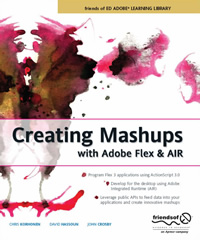
Creating Mashups with Adobe Flex and AIR
Mashups were becoming more popular so I read this book to learn how to create applications that incorporated web services, feeds, and APIs
using Adobe Flash and Flex together with HTML and JavaScript (Ajax).
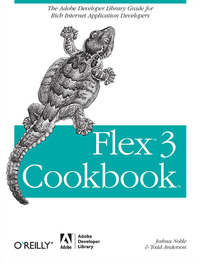
Flex 3 Cookbook
The first cookbook I read from O'Reilly. This book includes over 300 practical examples in code recipe format with detailed explanations and
ideas from community experts. You'll find everything from Flex basics, to solutions for working with visual components and data access, to
tips on application development, unit testing, and using Adobe AIR.
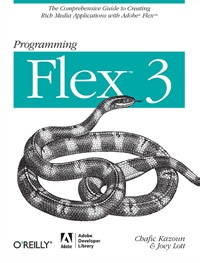
Programming Flex 3
Fantastic book that, in great detail, covers all you need to know about how Flex works. Covers core aspects, dives into the how and why of
certains things and includes many many examples of real-world things you'd include in an RIA built with the Flex framework.
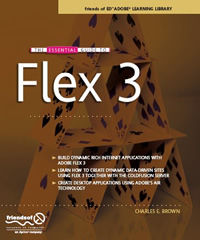
The Essential Guide to Flex 3 (Essentials)
Very easy read book with many step by step examples of how to use Flex to build RIAs. Also covers installing Flex and setting it up for use.
There's also explanations of using MVC in Flex and how to simplify otherwise complex tasks withing Flex using MXML and ActionScript.
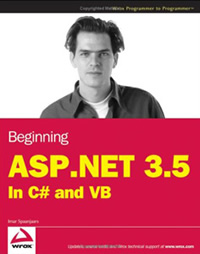
Beginning ASP.NET 3.5: In C# and VB (Programmer to Programmer)
It took me a while to get into ASP.NET - one reason was I used it when it first came to light (version 1.0). And like a lot of things MS does,
their first rodeo isn't always their best. But time changes everything and with version 3.5 the differences from that version and the one with
which I cut my teeth on were innumerable. This was a read when I actually wasn't using ASP.NET to dev with but within a year of finishing the
book I was tasked with building two web sites with it and was pleasantly surprised with the latest capabilities and also with Visual Studio - the
IDE of choice for ASP.NET programmers.
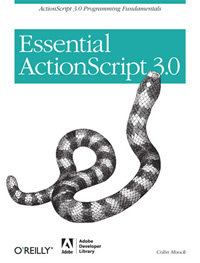
Essential ActionScript 3.0
Colin Moock's epic AS3 tome. If you want to know all about ActionScript 3.0 and I do mean all, this is truly the book for it. It covers
the basics on up to the advanced stuff. It became the #1 resource for those belonging to the Flash and ActionScript development community
and Moock is amazing at explainging things in this book.
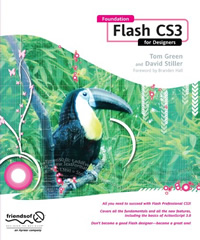
Foundation Flash CS3 for Designers
A book that covers the Adobe IDE Flash CS3 and demonstrates best practices and techniques used within that tool to build simple and both
complex solutions.
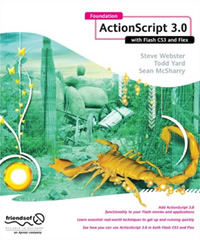
Foundation ActionScript 3.0 with Flash CS3 and Flex
This book helped me get a feel for how ActionScript 3.0 was used in both Flash and Flex. Plenty of great examples, well-written and accurate.
The book covered graphics, sound and video implementations.
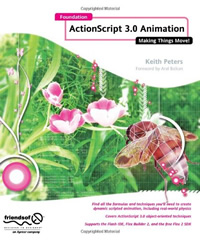
Foundation Actionscript 3.0 Animation: Making Things Move!
I had done ActionScript for a while - even been there when it was first acquired by Macromedia so I knew AS1 and AS2 fairly well but hadn't
been very much involved with the new fully object-oriented version of ActionScript until now. This was an easy read and a very good introduction
to anyone wanting to learn the "flashy" part of AS3.
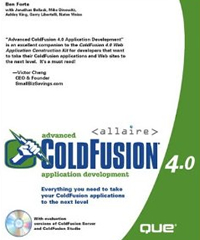
Advanced Cold Fusion 4 Application Development
Ben Forta's follow-up read for advanced implementation of Allaire's commercial rapid web application development platform. Equally voluminous
and equally effective if you were using ColdFusion to wire up web sites to relational databases. Cool thing was I was actually learning SQL
along the way because of this book.
The ColdFusion 4.0 Web Application Construction Kit
ColdFusion way back when was owned by Allaire and at this time a young but extrememly intelligent man named Ben Forta had already made his name as the
defacto expert on the language and had penned this massive 1000+ page book published by Cue.